
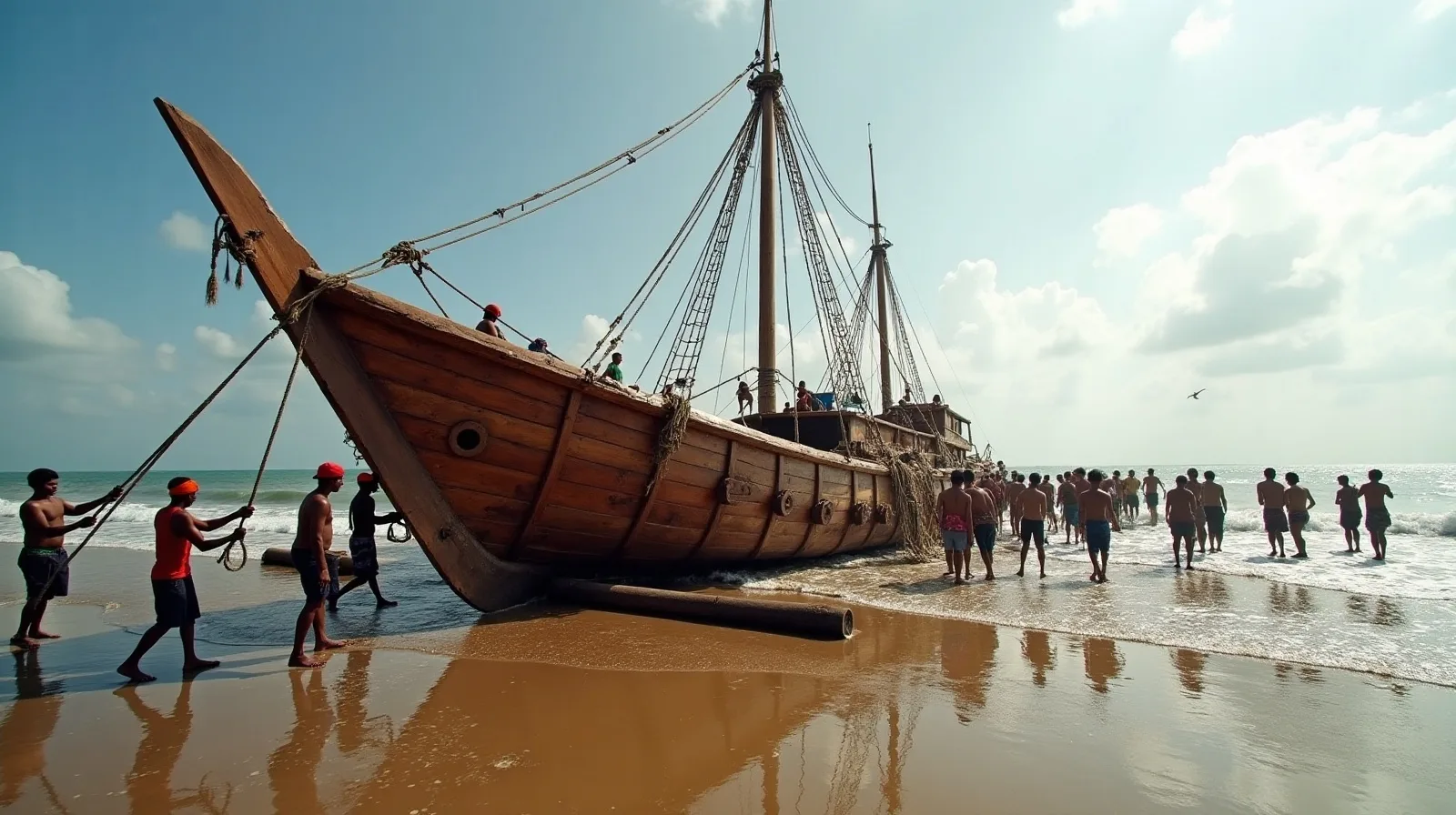
Annyorong Lopi: The Launching Ritual That Moves Ships by Hand
Annyorong lopi is the communal launching ritual of Bulukumba, South Sulawesi, in which a finished phinisi hull — often weighing well over a hundred tonnes — is moved from the beach into the sea largely by human effort: ropes, timber rollers, chants, and hundreds of hands from the surrounding Konjo villages. It is the public climax of a build that UNESCO recognised in 2017 as living intangible heritage, and for a modern owner it marks the contractual milestone between hull completion and fit-out afloat.
What Actually Happens at an Annyorong Lopi
By the time a launching day is set, the hull has stood on the beach at Tana Beru or Bira for a year or more, propped on hardwood shores a few dozen metres from the waterline. The yard prepares a track of greased timber skids and rollers running from the cradle down to the tide line. Heavy ropes are made fast to the hull, and on the appointed morning the community arrives — shipwrights from neighbouring yards, families, elders, and in recent years a growing circle of photographers and visiting owners.
The pull itself is rhythmic rather than brute. A caller leads chants, and the crowd heaves in unison on each refrain, walking the hull seaward a few centimetres at a time. Wedges and rollers are reset between pulls. Depending on the size of the vessel and the state of the tide, the move can take hours or, for the largest hulls, several days of staged work, with the final floating timed to a spring high tide. Modern yards may assist with winches or an excavator for the heaviest boats, but the form of the event — collective, vocal, ceremonial — remains what local tradition describes it to be: the village delivering a ship to the sea together.
The Ritual Layer: Ammossi and the Ship’s Navel
Before the hull moves, tradition calls for a sequence of rites led by the panrita lopi, the master shipwright who has led the build from the first day. The best known is ammossi: the cutting of the boat’s “navel”, a small ceremonial boring at the midpoint of the keel, accompanied by prayers and offerings. In Konjo belief the ceremony gives the vessel its own life and separates it from the land, the way a newborn is separated from its mother. Offerings and shared food follow — the details vary between villages and families, and the older generation holds parts of the liturgy privately.
It is worth being precise about what this means for an international client: the rituals are not a performance staged for visitors. They are how the yards themselves mark risk and responsibility at the moments a build changes state — keel-laying, navel-cutting, launching. We cover the full sequence of build ceremonies in our guide to phinisi construction rituals and milestones.
Why the Launch Is an Engineering Event, Not Just a Ceremony
Underneath the chanting, an annyorong lopi is a controlled heavy-lift operation executed with pre-industrial tools and centuries of accumulated judgement. The skid track must bear point loads of many tonnes without digging into the sand. The hull must be restrained on the slope so it cannot run free, and it must enter the water upright, taking up on its planking evenly as it floats. Shipwrights read the beach the way riggers read a crane chart: where the sand is firm, where the tide will reach, how the hull’s weight sits over the keel.
For the owner, launching is also a contractual and technical checkpoint. It is when the caulked hull first proves itself, when the wooden structure begins taking up moisture and settling, and when staged payments tied to hull completion typically close out. In the commissioning structures we manage, the launch sits between hull construction and fit-out afloat — engines, systems, and interiors are completed with the boat on the water. The sequence is laid out on our custom phinisi construction page.
Attending a Launch as a Client or Visitor
Launchings are public, joyful, and genuinely local events, and owners are welcome — most clients who attend describe it as the single most memorable day of their build. A few points of etiquette matter. Dress modestly, follow your yard host’s lead on where to stand (a moving hull commands respect), accept food if it is offered, and ask before photographing the ritual moments as opposed to the pull itself. If you would like your visit to coincide with a launching — your own vessel’s or another yard’s — tell us early; dates firm up only weeks ahead because they depend on tides and readiness. Practical directions, seasons, and visit arrangements are covered in our Tana Beru yard profile.
From the Beach to Working Waters
What makes the ritual more than heritage theatre is what happens afterwards: the hulls launched this way go to work. Boats built on this coast operate as commercial charter vessels in some of the most demanding cruising grounds in Indonesia, including the Komodo National Park fleet operated by our sister brand Komodo Luxury. A launching at Tana Beru is therefore the start of a service life measured in decades — you can trace where earlier hulls ended up in our completed phinisi portfolio.
How long does an annyorong lopi take?
From first pull to floating, anywhere from a few hours for a smaller hull on a favourable tide to several days of staged moves for vessels above roughly 40 metres. The final refloat is timed to high water, so the schedule is set by the tide tables as much as by the yard.
Can the launch date be fixed months in advance?
Only approximately. Yards will commit to a target month once caulking and finishing are on schedule, then fix the day two to four weeks out around the spring tides. We keep clients informed through build reporting so travel can be arranged in time.
Is the ritual required, or can an owner skip it?
The ceremonies belong to the yard and its community rather than to the client, and in practice no hull leaves the beach without them. Owners are guests of honour, not organisers. Most find that the ritual adds provenance and meaning to the vessel rather than delay — the engineering timetable, not the ceremony, sets the pace.
Does hand-launching risk damaging the hull?
A correctly executed beach launch loads the hull along its keel exactly as the structure is designed to be loaded. The technique has been refined over generations, and the same families who build the boats conduct the launch. Damage is rare and superficial when it occurs; the hull is surveyed afloat as part of handover in any case, a step we build into every commissioning agreement.
Planning a build — or want your yard visit to coincide with a launching? Message us on WhatsApp at +62 811-3941-4563 or write to bd@juaraholding.com and we will map the dates against the yards’ current order book.