
Hand Tools vs Power Tools in a Traditional Phinisi Yard
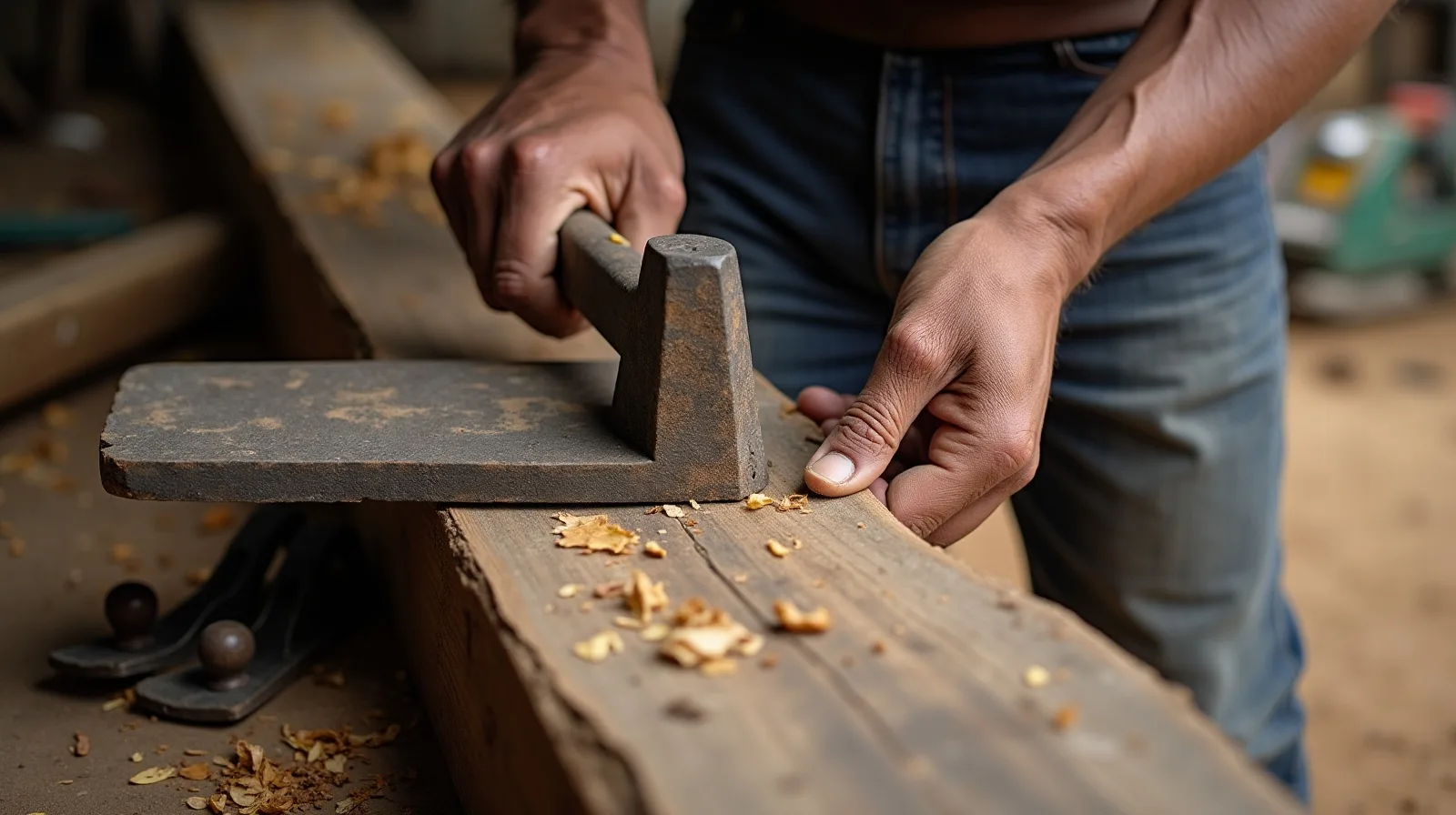
A traditional phinisi yard in Bulukumba runs on a deliberate mix: chainsaws, planers, and drills do the brute conversion work, while the adze, hand plane, chisel, and the master’s eye still govern every surface and joint that defines the hull. The rule of thumb on the beach is simple — power tools remove wood fast, hand tools decide where wood stops being removed. That division, not nostalgia, is why the yards adopted machines for labour without surrendering the shaping judgement that UNESCO recognised as living heritage in 2017.
The Toolkit You Actually See on the Sand
Walk the hulls at Tana Beru today and the soundtrack is mixed: two-stroke saws in the morning as baulks are broken down, then hours of rhythmic hand work — the knock of mallet on chisel, the hiss of a plane. The working inventory of a typical crew includes:
- Chainsaws — the modern pit-saw, used for felling conversion, rough-dimensioning planks, and cutting scarfs oversize.
- Electric hand planers and grinders — fast fairing of plank faces before the finish passes.
- Power drills — boring the thousands of dowel holes that edge-fasten a shell-first hull, and pilot holes for keel bolts.
- The adze (bingkung) — still the signature tool of the Konjo shipwright, swung to sculpt keel, stem, and the tight inboard curves no machine reaches cleanly.
- Hand planes, chisels, and spokeshaves — final fairing, joint fitting, and every surface a caulking iron will later meet.
- String, battens, and the eye — the measuring system: hull fairness is judged by sighting along battens and plank edges, a skill built through the apprenticeship we describe in how a Konjo shipwright is made.
Where Machines Won — and Why That Is Fine
Nobody in the yards romanticises the labour that machines replaced. Ironwood is brutally dense; converting it by hand consumed days per baulk and men’s shoulders with it. The chainsaw collapsed that cost, which shortened build times and made large commissions economically sane. The same applies to boring dowel holes: a drill does in seconds what a breast auger did in minutes, and the hole serves the same wooden dowel driven the same way. In every case where machines won, the criterion was identical — the tool changed the speed of the work, not the geometry of the result. The design authority stayed where it has always lived: in the panrita lopi, the master shipwright whose remembered geometry governs the hull.
Where Hand Tools Still Rule — and Why
Three zones of the build remain stubbornly manual, for reasons any boatbuilder will recognise:
Shaping to a remembered line. Phinisi hulls are built shell-first from proportions the master carries in memory — there is no lofting floor, no CNC file. A plank’s twist is worked in with heat, clamps, and hand fairing until it lands sweetly against its neighbour. The feedback loop is hand, eye, and experience; a power planer in the wrong hands removes in one pass what judgement needed to keep.
Joinery that must be watertight. Scarfs, rabbets, and the landing of garboard on keel are cut proud by machine and finished by chisel and plane to a fit you test with light. The caulked seams that keep the ocean out — covered in our post on caulking a wooden hull — depend on plank edges finished this way.
Curved structure. Naturally grown crooks for frames and knees are matched and sculpted individually. Every one is different; the adze and the eye are simply the right instruments.
What This Mix Means for Build Quality — and for Owners
The hybrid toolkit is a feature, not a compromise. Machines removed the bottlenecks that used to stretch builds and inflate cost; hand skills kept the hull geometry, joint quality, and repairability that give these vessels their working lifespan. It also keeps the craft teachable — apprentices still learn to read wood through tools that transmit feel. When we manage a commission, our quality checkpoints sit exactly at the hand-tool moments: joint fits before fastening, fairness before caulking, surfaces before finishing — the inspection logic built into our custom phinisi construction process. The proof of the method is in service: hulls finished this way run commercial seasons for our group’s charter operation, whose maintenance arm at Komodo Luxury boat services sees exactly how each yard’s workmanship ages.
Are any phinisi built entirely with hand tools today?
Not commercially. Every working yard uses chainsaws and drills for conversion and boring. The meaningful distinction is not hand versus power but which operations each is trusted with — and on that, the yards are remarkably consistent.
Does power-tool use reduce a hull’s authenticity or value?
No. UNESCO’s inscription protects the knowledge system — shell-first construction, the master’s geometry, the ritual sequence — not a ban on electricity. Buyers and surveyors judge the result: timber quality, joint fits, fairness. Those are still produced by hand skills.
What is the adze used for that a grinder cannot do?
Controlled sculpting of dense hardwood to a curved line with instant feedback. A skilled swing removes a precise ribbon of ironwood and stops; a grinder’s finish looks quick but wanders and burns on ulin. For keels, stems, and frame curves the adze is genuinely the better tool.
Can visitors watch the hand work up close?
Yes — mornings are full of it, and crews are generally happy to show a visitor the adze technique. Follow the etiquette in our guide to visiting the yards and you will see every tool in this post in use.
Want to see the toolkit applied to your own hull? Message us on WhatsApp at +62 811-3941-4563 or write to bd@juaraholding.com to arrange a yard visit and build discussion.