
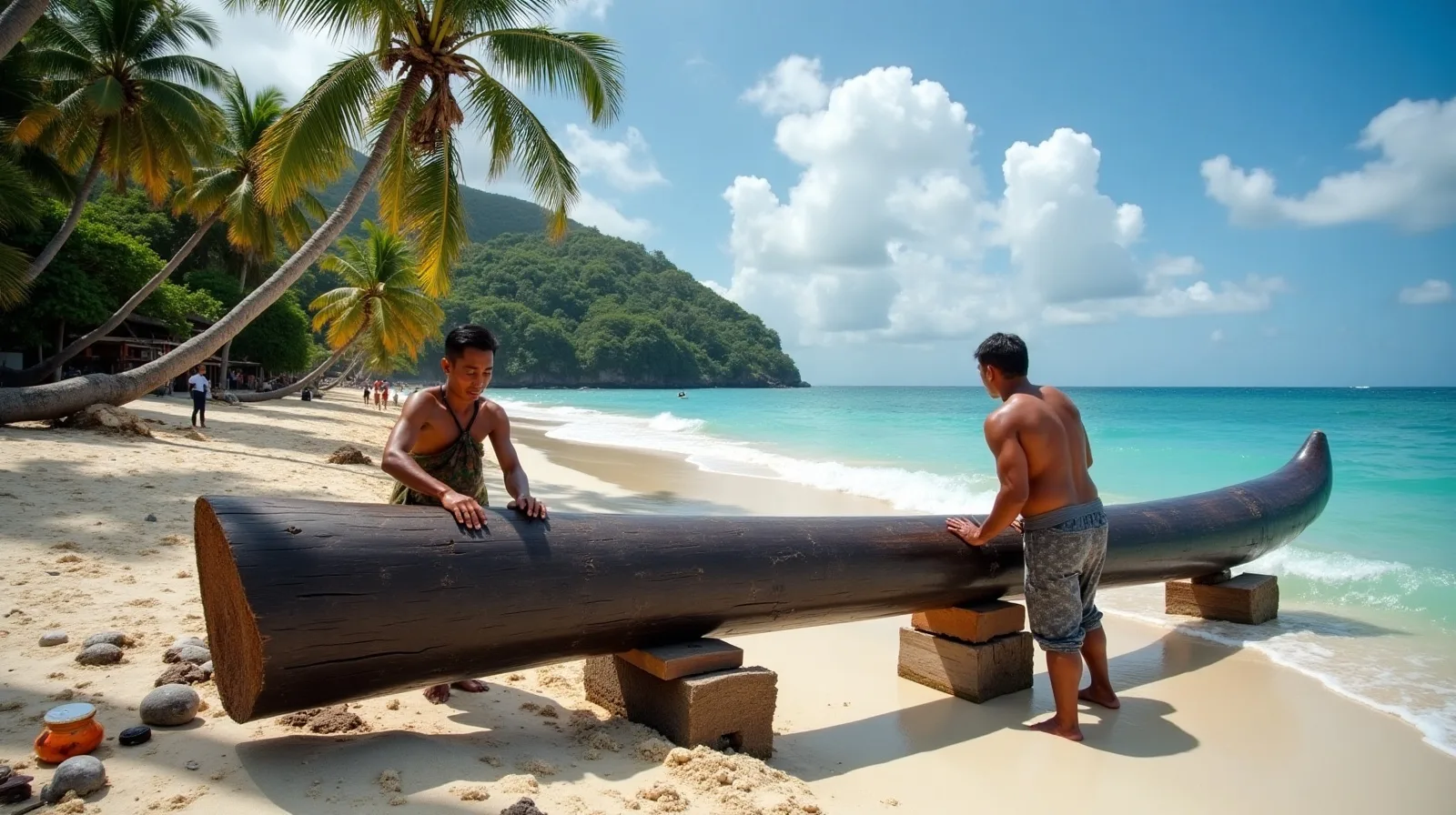
Laying the Keel: Ceremony and Engineering on the Bira Shore
Laying the keel of a phinisi on the Bira shore is both a ceremony and the single most consequential engineering decision of the build: a long, straight baulk of seasoned ironwood is aligned, blessed, and fixed as the spine that every plank, frame, and tonne of the future ship will bear on. Tradition marks the moment with prayers and offerings led by the master shipwright; contract practice marks it as the first major milestone payment. Get the keel right — timber, scarf joints, alignment — and the hull that grows from it can serve for decades.
The Keel as the Ship’s Contract With Physics
Everything a wooden ship endures ends up in its keel. It takes the grounding loads when a hull dries out, anchors the garboard planks, carries the ballast, and resists the sagging and hogging forces that work a long hull in a seaway. That is why Bulukumba practice reserves the densest, longest-seasoned ironwood — ulin — for keels and deadwood, and why the timber standards we publish for clients begin there; see our ironwood and teak standards for the grading rules. For hulls beyond the length of a single baulk, sections are joined with long scarfs, bolted and doweled, their positions chosen to sit away from the highest-stress midships zone.
What Happens on Keel-Laying Day
On the beach at Bira or Tana Beru, the day begins with the ground itself: heavy blocks are set and levelled so the keel will stand straight and true for the year or more of construction above it. The prepared baulk is carried in by the crew, sighted along its length, shimmed, and checked again — a fair keel is sighted by eye down its edge, an act of judgement the yards trust more than any laser.
Then the ritual layer begins. Local tradition calls for the panrita lopi to lead prayers and place offerings at the keel; in Konjo custom the keel timber is treated with the respect due to something about to become a living vessel. Families attend, food is shared, and the build is now publicly underway — the community has witnessed it. The ceremonial sequence continues at later milestones through to the launching ritual, which we describe in our post on annyorong lopi.
Ceremony and Engineering Are the Same Event
It is tempting for outsiders to file the offerings under folklore and the alignment under engineering, but on this coast they are one act: the ritual publicly binds the master’s reputation to the straightness of that keel. A panrita lopi who blesses a keel is declaring, before his village, that the timber is sound and the geometry is his. In a knowledge system without drawings — where the hull’s proportions live in the master’s memory — that public accountability is the quality system. UNESCO’s 2017 inscription of pinisi boatbuilding recognised precisely this fusion of rite and craft.
Modern commissions add a second, documentary layer on top: we photograph and log the keel timber’s provenance and seasoning, record scarf positions, and verify alignment before the milestone payment releases. The two systems reinforce each other, and the combined record becomes the first chapter of your vessel’s build file — the documentation discipline that runs through the whole construction process.
From Keel to Shell: What Follows
Within weeks of keel-laying, stem and sternpost rise at the ends, and then the defining move of boat building in Sulawesi begins: planking is hung before framing. Plank by plank, edge-dowelled to its neighbour, the shell takes shape around the master’s remembered geometry, and only later are frames shaped to fit the finished shell. The keel’s straightness governs everything that follows — a twist at the spine becomes a twist in the ship. This shell-first sequence, and how modern engineering documentation wraps around it, is central to what makes a Bulukumba hull distinct from Western practice, and it is why the keel ceremony carries the weight it does.
For an owner, keel-laying is also the moment your project becomes physically real and financially staged. It is typically the first of the milestone payments that run keel — hull — launch — fit-out — handover, the structure explained on our how to commission page. Vessels that begin this way end their build afloat in charter service across Indonesia, many operating in Komodo waters with our sister brand’s fleet, whose construction arm is Komodo Luxury boat construction.
How is the keel timber chosen?
From the yard’s oldest, straightest seasoned ironwood stock — selected for grain, freedom from heart defects, and length. The master sights and sounds the baulk, and on managed commissions we add provenance records and moisture readings so the choice is documented, not just trusted.
Can I attend my boat’s keel-laying?
Yes, and we encourage it — it is the natural first yard visit of a build. The date is set by yard readiness rather than tides, so it can usually be fixed several weeks ahead. Practicalities for getting there are in our guide to visiting Bulukumba as a client.
What if my hull is longer than any single ironwood baulk?
Keels for larger phinisi are built from two or three sections joined with long bolted scarfs — standard practice for wooden ships everywhere. Scarf placement and fastening are specified and inspected; a well-made scarf is not a weakness.
Does the ceremony delay the engineering schedule?
No. The ritual occupies a morning; the levelling, sighting, and fixing of the keel is the same day’s work. Ceremony and construction have shared this coast’s calendar for generations.
Ready to put a keel down with your name on the build file? Message us on WhatsApp at +62 811-3941-4563 or write to bd@juaraholding.com to discuss specification and yard availability.