
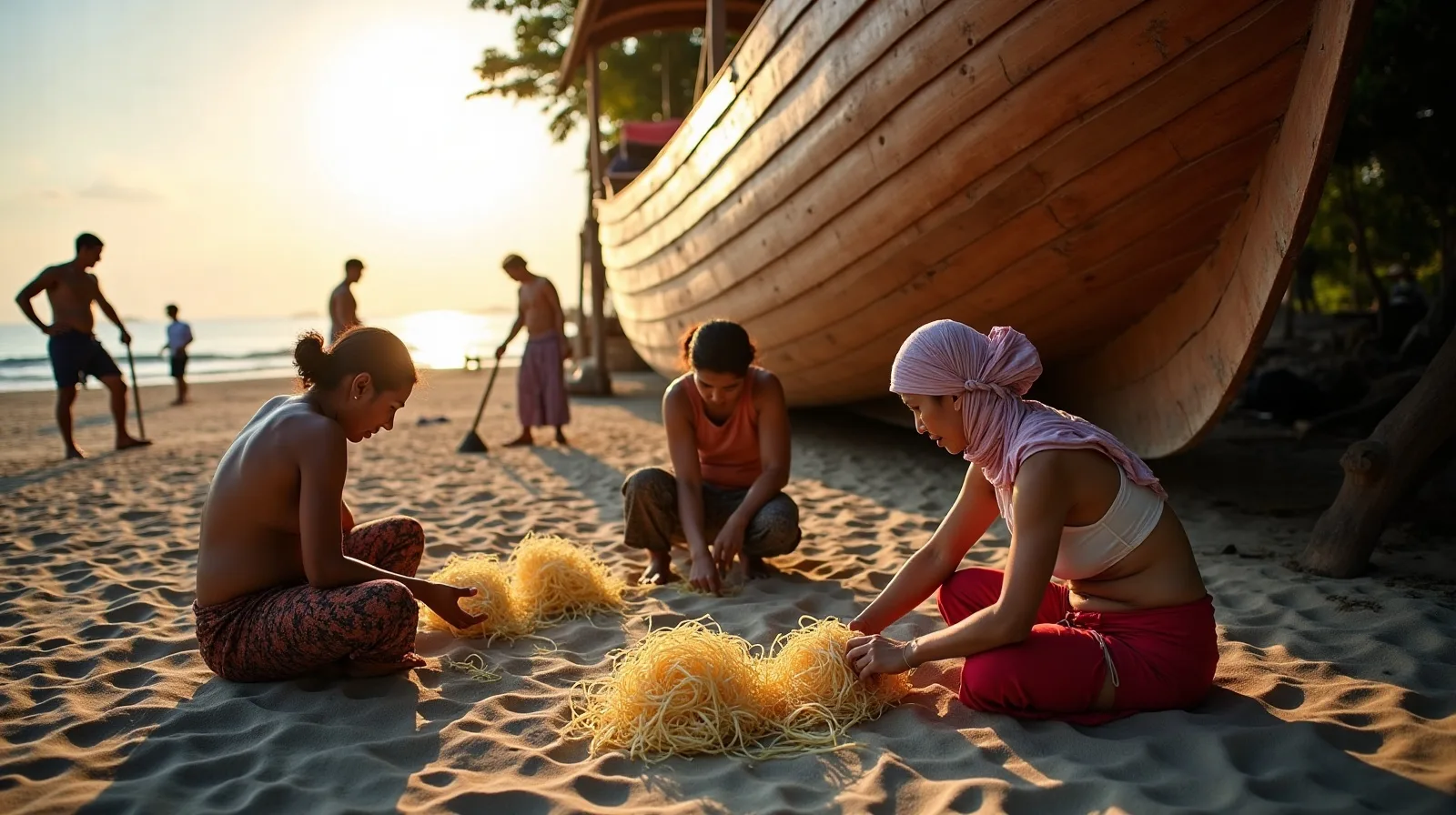
Women of the Yards: The Unseen Workforce Behind Phinisi Building
Phinisi building in Bulukumba is photographed as a world of men with adzes, but the yards have always run on a second, largely unrecorded workforce: women. Historically they spun and wove the sails, prepared the caulking fibre, managed the household economies that financed builds, and cooked for the work crews and launch feasts that make a hull possible. Today women also run yard administration, client communication, finishing and interior work — and in several building families they are the ones keeping the books that keep the craft alive.
The Work That Never Made the Photographs
Walk the beach at Tana Beru and the visible labour is male: shaping, planking, caulking, rigging. What the camera misses is everything that surrounds the hull. In the sailing era, the sails themselves were women’s work — cotton spun, dyed, and woven in the villages while the hull rose on the beach. The fibre driven into every plank seam was cleaned, sorted, and rolled by women before a caulker ever picked up his iron, a preparation stage we describe in our piece on the caulking craft. And on the days that decide a build — keel laying, launching — the feasts that gather two hundred pairs of hands are planned, funded, and cooked by the women of the building family.
Household Economics: Who Really Finances a Build
In Konjo building families the household purse is traditionally managed by women, and a yard is a household enterprise. When a client’s tranche arrives, it is very often a wife, mother, or daughter who allocates it — timber first, wages next, the family’s margin last. When a build hits a lean month, it is her savings discipline that keeps the crew fed. Anthropologists who have worked on this coast describe women as the financial managers of the boatbuilding economy, and the builders themselves will tell you the same thing with a smile.
That role has scaled up with the industry. The larger yards now handle international clients, staged USD contracts, and supplier invoices, and in many of them the administration is run by the family’s younger women — often the first generation with formal schooling in accounting. The men shape the ship; the ledger that proves the build to a foreign buyer is frequently a woman’s work.
New Roles in the Modern Yard
The charter-yacht era has widened the yard’s scope from hull to habitat, and much of that new territory is worked by women. Interior finishing, upholstery and soft furnishings, varnish and detail painting, provisioning of completed vessels, and the guest-facing standards a charter boat must meet — these draw on skills the villages already had. On crewed vessels, hospitality roles are increasingly filled by women from the same communities that built the boat. The transformation of the coast’s product, which we trace in our heritage and modern craft essay, has quietly been a transformation of who works on it.
What has not changed is the apprenticeship of the hull itself — shaping and planking remain a male lineage craft, passed father to son as described in our apprenticeship story. The point is not that every role is interchangeable; it is that the craft was never sustained by half the village alone.
Ritual life, too, runs on women’s authority. The feasts that sanctify a keel laying or a launching are not catering — they are the ceremony’s substance, prepared to standards and sequences the senior women hold, with specific dishes belonging to specific rites. When several hundred people arrive to pull a hull to the sea, they are fed by a kitchen operation planned like a small military campaign, and everyone on the coast knows which households do it best. A launching remembered as generous reflects on the vessel itself; the boat begins its life inside that memory.
Why This Matters to a Modern Owner
Commissioning a phinisi means engaging a community, not hiring a contractor. Clients who understand the whole workforce — who greet the family matriarch, who fund the launch feast generously, who notice the finishing crew as well as the shipwrights — are remembered on this coast, and their boats are remembered with them. When you visit a build at the Tana Beru yards, you are walking into an economy of households; conduct yourself as a guest of all of them. The vessels this community delivers end up in demanding service across Indonesia, including the fleet standards maintained by our sister brand Komodo Luxury — standards the finishing workforce helps meet.
Did women historically build hulls in Bulukumba?
Hull carpentry has been a male craft by custom, and remains so. Women’s traditional domains were sailmaking, fibre preparation, ritual food, and the household finance of the build — domains without which no hull reached the water.
Are women visible in the yards today?
Yes, though mostly away from the plank stacks: in yard offices, finishing and interior teams, provisioning, and the ceremonial days when the whole village turns out. Client-facing administration in the larger yards is very often run by women of the building family.
Does a visiting client need to observe any etiquette?
Standard village courtesy: dress modestly, accept hospitality, and greet the senior women of the household as respectfully as the master builder. If you are invited to a family meal during a yard visit, that is a mark of trust — take it.
Is this changing with the younger generation?
Steadily. Daughters of building families increasingly handle contracts, bookkeeping, and digital communication, and hospitality careers on charter vessels are drawing young women into the maritime economy. The craft’s future workforce is wider than its past one.
Planning a yard visit or a build of your own? Message us on WhatsApp at +62 811-3941-4563 or write to bd@juaraholding.com — we will introduce you to the yards, and to the families behind them.