
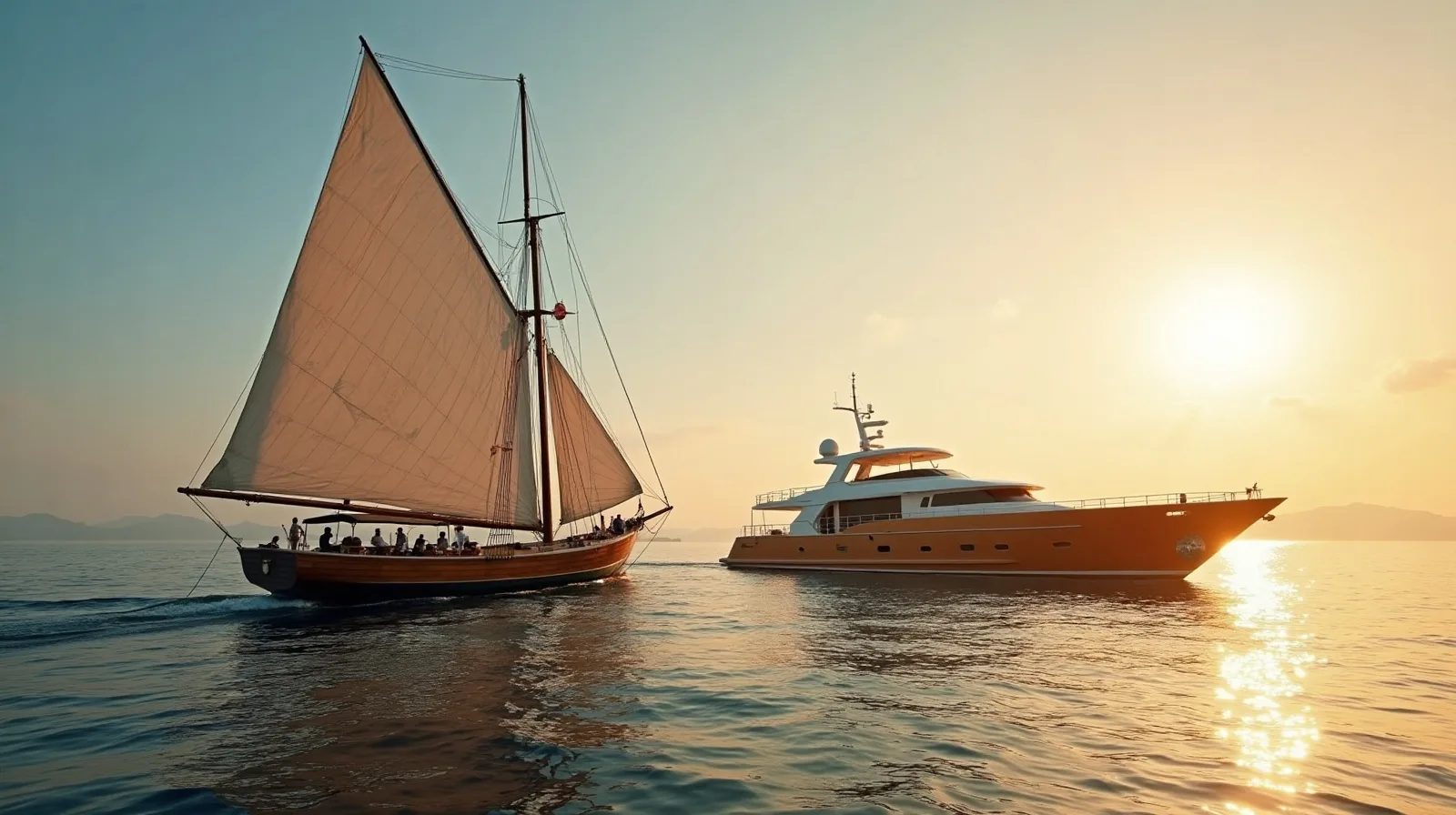
From Cargo Schooner to Yacht: The Bira Coast’s Great Pivot
Within two generations, the Bira coast pivoted from building cargo schooners that carried copra and timber across the archipelago to building some of the most sought-after charter yachts in Asia. The phinisi survived the death of sail freight by changing what it carries — from cargo holds to guest cabins — while keeping the hull craft, the families, and the beach-building method intact. Understanding that pivot explains almost everything about why a Bulukumba yacht is built the way it is today.
The Working Centuries: Copra, Timber, and Rice
For most of the twentieth century, the phinisi was a truck. Fleets of gaff-ketch rigged schooners built on this coast worked the inter-island trades — copra out of Sulawesi, timber from Kalimantan, rice, cement, and everything else the archipelago moved by sea. The ships were owned in trading families, crewed by relatives, and financed against future cargo profits. Design followed function: capacious holds, sea-kindly hulls that could take the Java Sea in both monsoons, and rigs a small crew could work. Those requirements — carrying capacity, seakeeping, repairability anywhere — are the DNA that later made the type such a natural liveaboard platform.
Motors, Decline, and the Lean Years
From the 1970s onward, engines rewrote the trade. Motorised phinisi — hulls with shortened rigs and big diesels — outcompeted pure sail, and then steel ships and containerisation outcompeted them. Sail freight faded; the great schooner fleets shrank; and by the 1990s the yards of Tana Beru and Bira faced the question that kills most traditional crafts: who still needs what we make? Some families left the trade. The ones who stayed built fishing boats, small motor freighters, and kept the knowledge alive on thinner and thinner margins. The story of how the craft endured that squeeze is part of our heritage essay.
The Pivot: Divers, Dreamers, and the Charter Boom
Rescue came from an unexpected direction: tourism. Dive operators in the 1990s and 2000s discovered that a phinisi hull made a superb liveaboard — roomy, stable, romantic, and buildable at a fraction of the cost of a Western yacht. Early conversions of working boats gave way to purpose-built vessels, and when Komodo and Raja Ampat became global destinations in the 2010s, demand for new charter phinisi surged. The yards found themselves building for owners who wanted en-suite cabins where cargo holds had been. What changed and what did not is a study in adaptation: hull form, timber, and beach method endured, while everything above the waterline was rethought — a contrast we detail in cargo versus liveaboard construction.
Today the finished vessels sail straight into that economy, many serving itineraries alongside the fleet of our sister brand Komodo Luxury in Komodo National Park.
The pivot also rewrote the economics of the villages. A cargo schooner earned its keep slowly, over seasons of freight; a charter phinisi earns in weekly bookings, and its owner reinvests in maintenance, crew, and eventually the next hull. Money now flows back to the beach faster and more predictably than the copra trade ever managed, and the yards have responded the way healthy industries do — training more hands, holding more timber, and taking on more ambitious builds. The grandfathers who watched sail freight die could not have imagined that the same beach would one day have a waiting list.
What the Pivot Means for a Modern Buyer
First, you are buying a proven platform, not a nostalgia project: the hull type earned its shape in decades of commercial seafaring, and the same families who built the traders build your yacht — walk the Bira yards and the continuity is standing in the sand. Second, the modern additions — engineering, systems, glazing, interiors — are the newest layer of the craft, which is why specification and supervision matter most there; our custom construction page explains how we manage that layer. Third, the pivot is still running: yards keep absorbing new standards, from navigation electronics to charter-class safety gear, without surrendering the method that makes the boats what they are. The recent chapters of that evolution are traced in modern systems in a traditional hull.
One habit from the freight centuries deserves special notice: overbuilding. Cargo masters wanted hulls that could ground on a drying berth, load hard, and be repaired in any port with local timber. Yacht owners inherit that conservatism for free — scantlings and joinery sized for working abuse, now carrying guests instead of copra. It is why well-kept phinisi age in decades rather than years.
When was the last real cargo schooner era?
Sail freight declined steeply once motorisation spread in the 1970s–80s. Motorised phinisi carried regional cargo for decades longer, and a working remnant still does — but as the exception, not the fleet.
Were the first liveaboards converted cargo boats?
Many were, in the 1990s and 2000s. Purpose-built charter hulls followed as demand grew, and today’s market is overwhelmingly new-build: designing guest accommodation into the hull from the keel up produces a better vessel than any conversion.
Did the pivot change how hulls are built?
Below the waterline, remarkably little: same timber logic, same planking craft, same beach launching. The transformation lives above deck — superstructures, systems, and interiors that cargo builders never needed.
Is another pivot coming?
The yards are already flexing toward it: expedition yachts for private owners, research and dive support vessels, and refit work on the first liveaboard generation. The pattern of this coast is constant — the hull stays, the cargo changes.
Curious what the current generation of hulls could carry for you? Message us on WhatsApp at +62 811-3941-4563 or write to bd@juaraholding.com and we will walk you through the modern order book.