
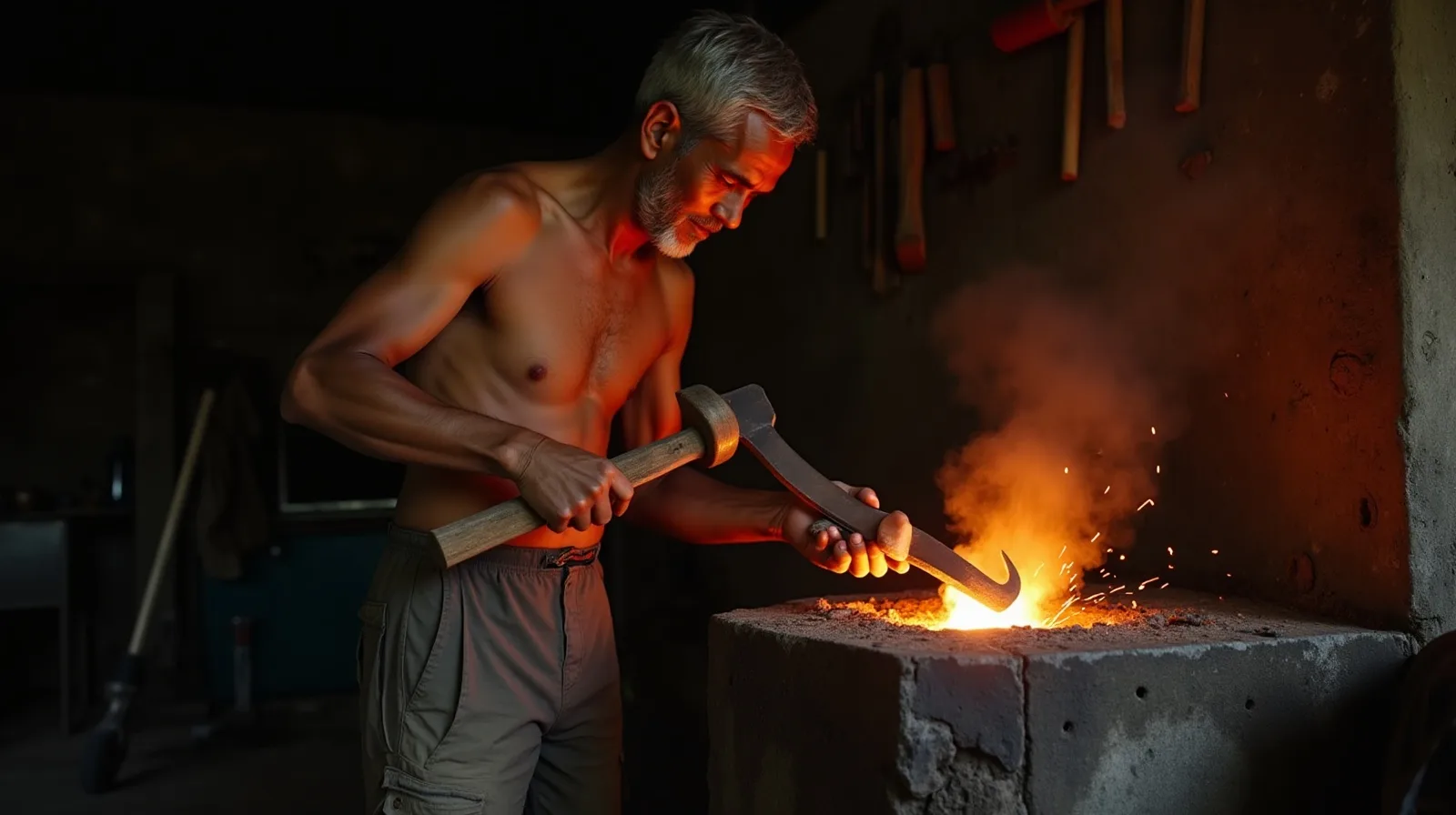
The Toolmaker of Bira: Forging Adzes for a Living Craft
Behind every phinisi hull stands a smaller, hotter workshop: the village forge where the shipwrights’ tools are made and remade. The adzes, chisels, and caulking irons of the Bulukumba yards are not catalogue items — they are forged locally, often from recycled vehicle spring steel, in patterns refined for the specific curves of phinisi work and the specific hardness of ironwood. The toolmaker is the craft behind the craft, and his forge is one of the reasons hand tools remain competitive on this coast.
The Forge Behind the Beach
A short walk inland from the hulls, the sound changes from adze-thud to hammer-ring. Village smithies around Bira and Tana Beru work in the old Southeast Asian pattern: a charcoal hearth, hand- or blower-fed air, an anvil, and a smith who has learned steel the way the shipwrights learned timber — by family transmission. The raw material of choice is leaf-spring steel from trucks and cars: easy to source, forgiving to forge, and capable of taking the hard, tough edge that ulin and teak demand. A blade begins as a straight spring, is cut, drawn out, curved, and finally hardened and tempered by eye — the smith reading the steel’s colour the way a builder reads a plank’s grain.
An Adze Is Not One Tool but a Family
The shipwright’s signature tool, the adze — bingkung in the local usage — comes in a graded family of shapes. Broad, nearly flat blades hog off timber when a baulk is first squared; tighter-curved heads hollow the inside of planks so they seat against the frames; small, short-handled patterns work joints and closures where a full swing is impossible. Each master owns a set matched to his own swing and to the hull sections he specialises in, and a good smith adjusts curvature and edge angle to the individual buyer. Alongside the adzes come caulking irons in several widths — the seam tools whose work we describe in our caulking piece — plus boring augers, slicks, and the wedges that hold a build together before the fastenings go in.
Why Hand-Forged Beats Catalogue on This Coast
Imported edge tools exist, and the yards use plenty of modern equipment — chainsaws for conversion, power planers for fairing, as we set out in hand tools versus power tools. But for the shaping strokes that define a hull, forged local blades keep winning on three counts. They are tuned: curvature, weight, and haft angle are made for phinisi sections, not for generic carpentry. They are maintainable: a blade that meets a hidden nail in recycled timber is reforged at the village smithy in a day, not shipped anywhere. And they are economical in the deepest sense — a tool that lasts a working generation and can be reborn from the same steel again. The result is visible in the timber: the faceted, faired surfaces of a hand-adzed hull, the joinery described in our plank-joining guide.
Watching a smith fit a blade to its buyer is a study in bespoke manufacture. The shipwright arrives with his old adze, or with a description of the hull section he is working; the smith reads the man’s height, his swing, the wear pattern on the previous edge, and adjusts the new blade’s curve and the haft’s angle accordingly. Two masters doing nominally the same job on the same hull may carry visibly different tools. It is the opposite of standardisation, and it is precisely why the tools disappear so naturally into the work — each one is an extension of a specific pair of hands.
A Craft Ecosystem, Not a Single Skill
The forge illustrates the deeper truth about this coast: phinisi building is an ecosystem of interdependent trades — timber scouts, sawyers, smiths, shipwrights, caulkers, riggers — concentrated in a few villages around the Bira and Tana Beru shore. Remove any one of them and the economics of the whole craft shift. When you commission a hull here, your budget feeds that entire ecosystem, which is precisely why the skills still exist at working scale — and why the vessels that emerge can be maintained for decades by the same network, a continuity our sister brand Komodo Luxury’s boat services relies on for its own fleet.
Are the tools really made from car springs?
Very commonly, yes. Leaf-spring steel is a medium-carbon alloy well suited to edge tools: tough enough to survive shock on ironwood, hard enough to hold an edge, and available everywhere vehicles die. Smiths also work other salvaged stock when the steel reads right.
Can a visitor buy a forged adze as a souvenir?
Often, if arranged through a yard host — smiths take commissions, and a made-to-order blade is a far better memento than anything from a shop. Allow a few days, and remember an adze is a bladed tool for your airline luggage planning.
Do young smiths still enter the trade?
Fewer than the yards would like, which mirrors apprenticeship pressures across the craft. Steady building demand is the best protection: as long as hulls rise on the beach, the forge has customers and successors have a reason to stay.
How long does a forged blade last?
With regular sharpening and occasional re-tempering, a working lifetime. Edges are dressed daily on stones; a damaged blade goes back to the fire and returns as itself — or as a different tool entirely. Steel, like timber here, is never wasted.
Want to see the forges and the yards they serve? Message us on WhatsApp at +62 811-3941-4563 or write to bd@juaraholding.com and we will include the smithies in your visit itinerary.